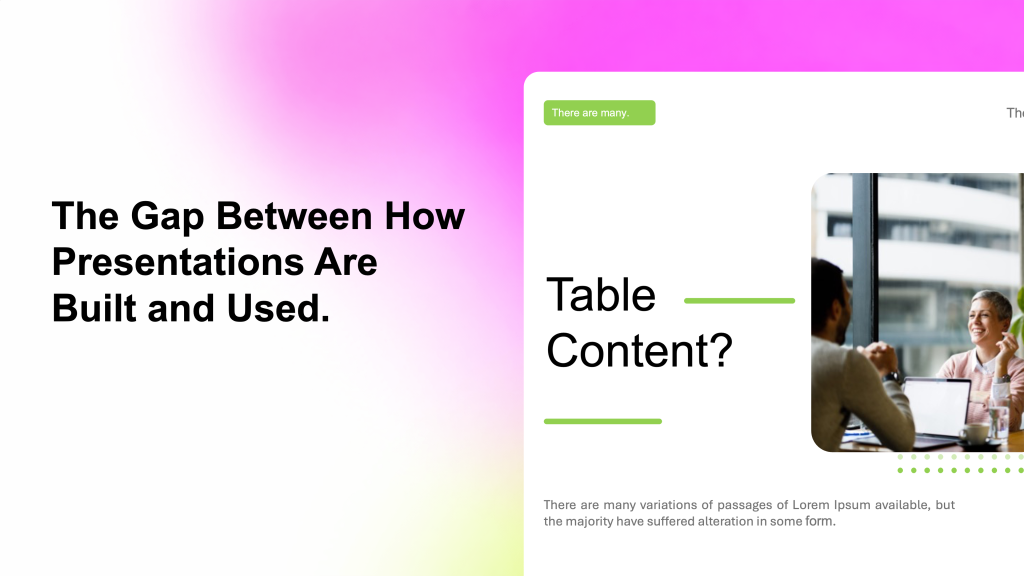
Most presentations are designed for a scenario that rarely happens anymore, a live meeting where a presenter controls the narrative slide by slide. Reality is much less predictable. Decks are forwarded, skimmed, and referenced long after the meeting ends. Without the presenter’s context, the original meaning often gets lost.
This disconnect between design and actual use is one of the biggest challenges in corporate communication today. It exposes a fundamental gap between what we intend to say and what the audience absorbs outside the boardroom.
The mismatch between intent and reality.
When you build a deck, your intent is focused. Whether you are pitching a concept or aligning a team, the flow feels logical because you assume you will be there to connect the dots and guide attention.
But the moment you email that file, it stops being a visual aid and becomes a standalone document. It must carry its own meaning, this is where the original intent breaks down, the content isn’t necessarily wrong, the structure simply wasn’t built to survive without an explanation.
Why this gap is becoming more visible.
We share files more fluidly than ever before. A deck built for a specific Tuesday meeting is forwarded to an absent stakeholder on Thursday and then repurposed for a different conversation the following week.
In each scenario, the audience’s expectations change, but the slides remain static. This creates immediate friction between what the presentation says and what the reader can understand on their own.
A structural issue, not a visual one.
When a deck misses the mark in these situations, it’s rarely an aesthetic problem. It’s a structural failure. Information isn’t organized for independent reading, transitions are left implied rather than explicitly stated.
In too many cases, the design depends entirely on a voice track. Without the speaker, the hierarchy of information collapses, even if individual slides look flawless. The gap is structural because we are focusing on individual slides rather than the underlying framework.
What this means for presentation design.
Fixing this doesn’t require adding complexity. It requires a shift in how presentations are approached from the start. We need to stop treating them as scripts for a live performance and start treating them as systems of information.
Addressing this gap means building a clear communication hierarchy that remains legible across any context. When you adopt this perspective, the priorities change, structure becomes more important than decoration, absolute clarity outweighs pacing, and the logical relationship between slides matters more than the appearance of a single page.
The way information flows inside organizations has permanently changed.
The presentations that perform best over time aren’t necessarily the most visually refined. They are the ones that are structurally sound, the ones that remain perfectly understandable when the original context is removed, the presenter is absent, and the audience interacts with the information in entirely unexpected ways.