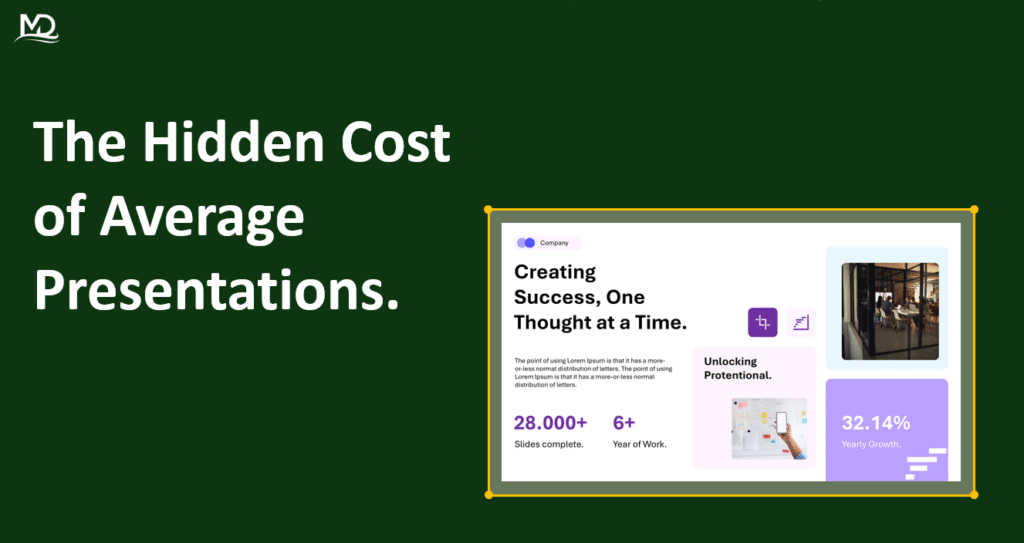
In most organizations, presentations are routine. Teams meet, slides are shared, and another deck makes its way through the cycle, but behind that routine lies a problem few talk about, the silent cost of “good enough.”
Average presentations don’t crash meetings or ruin deals outright, they simply fail to move anything forward, and over time, that invisible drags lost attention, missed clarity, diluted messages becomes one of the biggest hidden costs in business communication.
Why “good enough” is costing more than they think.
The irony is that most presentations today look fine. The slides are branded, the fonts match, and the colors are on point, but they clarify strategy, inspire confidence, or help decisions get made faster.
Here’s what happens when teams settle for average:
- Meetings multiply because nothing gets decided.
- Clients nod politely but never convert.
- Teams leave unclear about direction or next steps.
- Leaders spend hours refining slides instead of refining the message.
Each one of these moments might seem small, but together they form a pattern, slow erosion of momentum, credibility, and trust.
What separates effective presentations from average ones.
As a presentation design agency, we’ve seen firsthand how much difference it makes when a deck is treated as a strategic asset instead of a checkbox.
Here’s what the best communicators do differently:
1. They design for clarity, not decoration.
Average decks overwhelm with details, exceptional ones simplify without dumbing down. Every visual, chart, or line of text leads to one clear takeaway, what this means and why it matters.
2. They connect logic with emotion.
Facts convince the brain, but emotion drives action, best presenters know how to balance both, using flow, tone, and rhythm to make data feel relevant, not distant.
3. They respect the audience’s time.
Attention is expensive, strong decks get to the point fast, guiding the audience through a clear story instead of forcing them to find meaning in cluttered slides.
4. They make the deck work beyond the meeting.
An average presentation ends when the meeting does. A great one becomes an internal asset, a tool for onboarding, alignment, or investor outreach. It’s designed with longevity in mind.
The cost of treating presentations as tasks.
We’ve noticed a common pattern across industries, teams treat presentations as something to “get done” rather than something to get right.
That approach often leads to:
- Rushed design decisions: Slides are made overnight, clarity disappears.
- Template thinking: The story feels generic instead of intentional.
- Disconnected storytelling: The flow doesn’t match what the audience needs to understand or decide.
- Lost influence: The message doesn’t stick, even if the meeting went smoothly.
Every one of these habits has a cost in missed opportunity. A pitch that could’ve closed, a strategy that could’ve landed, a leader who could’ve inspired but didn’t.

Where presentations lose their power.
It’s rarely one big mistake that makes a presentation fall flat, it’s a series of small misalignments along the way:
- Strategy and design are disconnected. The message is written by one person, visuals by another, and neither fully understands the audience’s goal.
- Data leads, story follows. Instead of shaping a narrative around key insights, teams paste charts and expect clarity to emerge on their own.
- Revisions replace reflection. Decks go through endless edits but few strategic conversations about what the presentation should achieve.
- Everyone adds input, no one owns the story. The result looks polished but feels hollow, like a deck that says everything yet means nothing.
When presentations are built this way, they might check every box on the content list, but they don’t move people, and that’s where most companies lose the real opportunity: not in bad design, but in lack of alignment between message, visuals, and intent.
Final thought.
Average slides might save time today, but they will cost far more in the future. Because every unclear message delays a decision, every confusing slide weakens trust, and every missed story moment wastes attention that won’t come back.